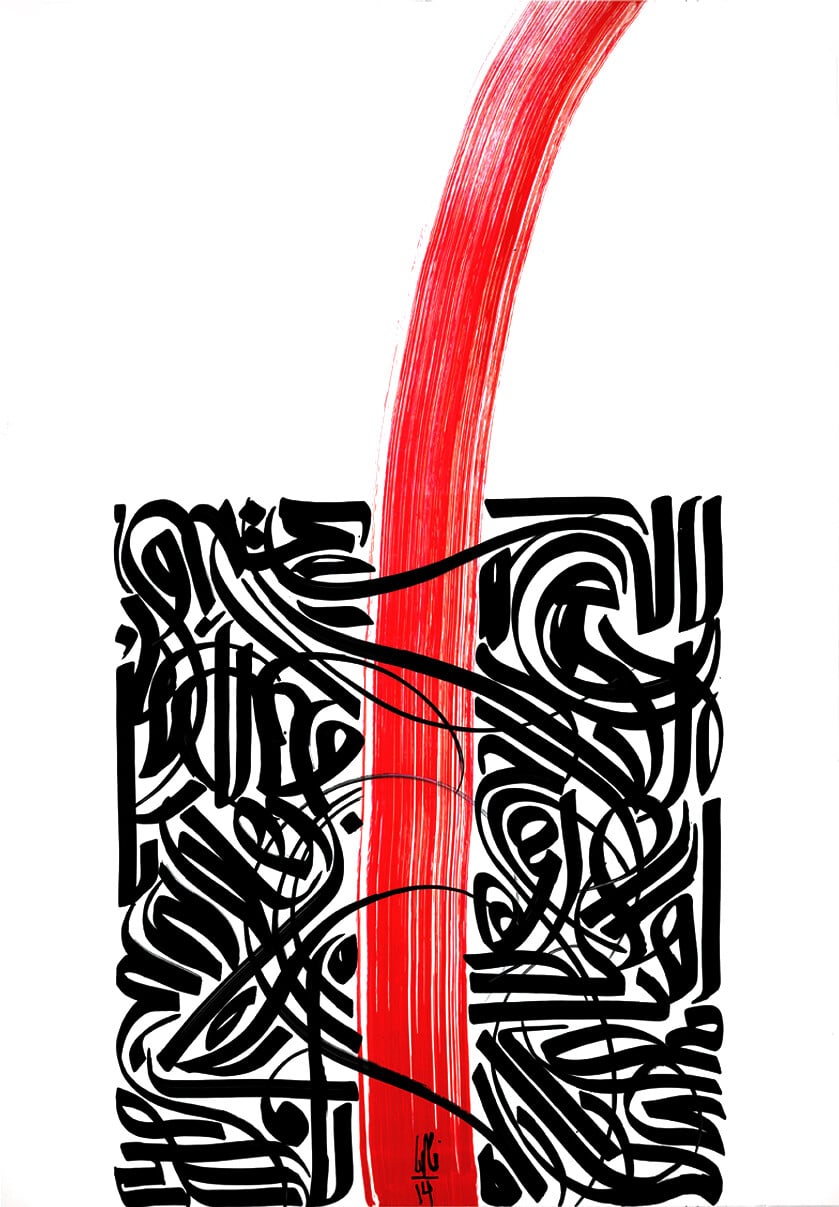
In this unique piece, "RAVAAN II", Sasan Nasernia transforms Persian calligraphy into a field of abstract rhythm. Interlaced black script forms a dense, intricate structure, interrupted and energized by a bold vertical stroke of red. This striking contrast evokes the flow of ravaan — “spirit” or “mind” — …
Color
€3,200
Payment Options
Full price
Or pay in installments:
Installment payments are subject to approval. Interest may apply.
See terms and conditions for details.
Artwork Details
Material
Acrylic on Cardboard
Size
Calligraphic Confluence, Mestaria Gallery
Rarity
Unique
Signature
Hand-signed by artist
Certificate
Included (issued by gallery)
Frame
Not included
Genres
About the Artist
Sasan Nasernia
Iranian, b. 1974
Iranian, b. 1974
Sasan Nasernia began his career primarily as a calligrapher and typography artist. Exploring different avenues in Persian and Arabic classical and modern calligraphy, he has since expanded his practice to include painting, print, digital work and installation. Nasernia explores many themes in his practice. He is broadly interested in playing with the tension between two opposing primordial elements of order and chaos. Sometimes borrowing from traditional Persian paintings and iconography, he immerses these elements in abstraction and ambiguity, infused with his letterforms. Nasernia also employs the icons of our world – past and present - to create a visual lexicon of his own. Nasernia’s approach to calligraphy has always been a personal journey to find novel ways to create letter forms out of the most contemporary concepts. By deconstructing the rules of Arabic and Persian calligraphy and borrowing from the earliest types of this form of art, he has developed his signature format of writing, which he playfully calls“ Crazy Kufic.” According to Nasernia, “Crazy Kufic” and its unique characteristics allow the artist to explore the concept of fluidity and uncertainty in our natural and extramundane worlds. In his recent attempts, he tries a new approach towards the structure of his calligraphic art, where most times a text is completely devoid of meaning; while in contrast, an empty space or a simple symmetrical juxtaposition may suggest a metaphysical conjecture or even an existential "raison d’être".